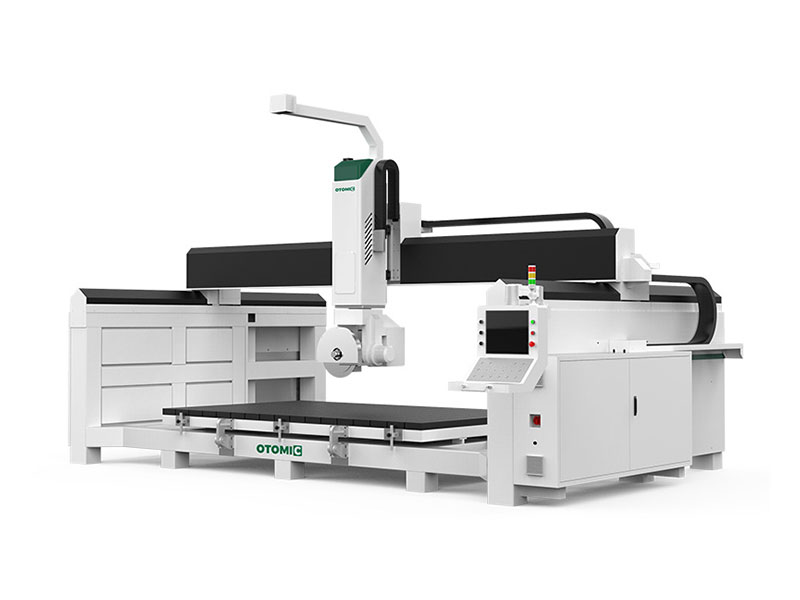
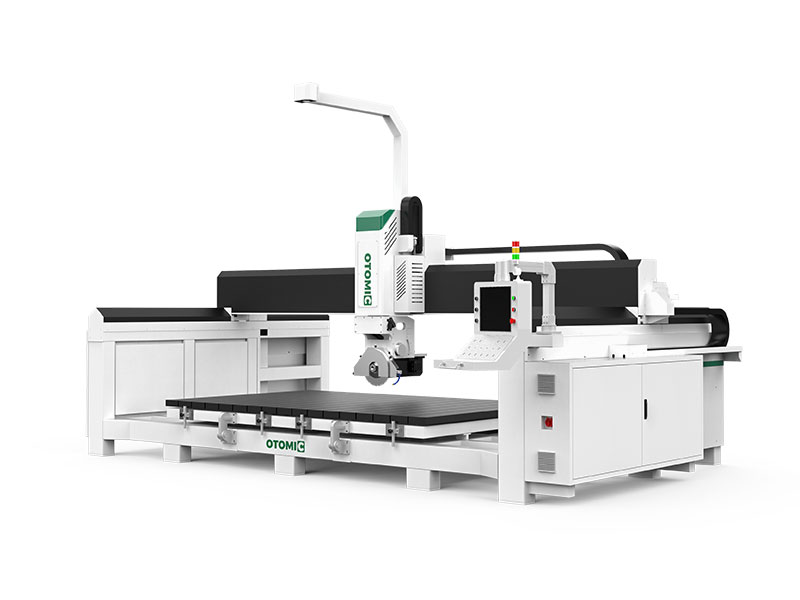
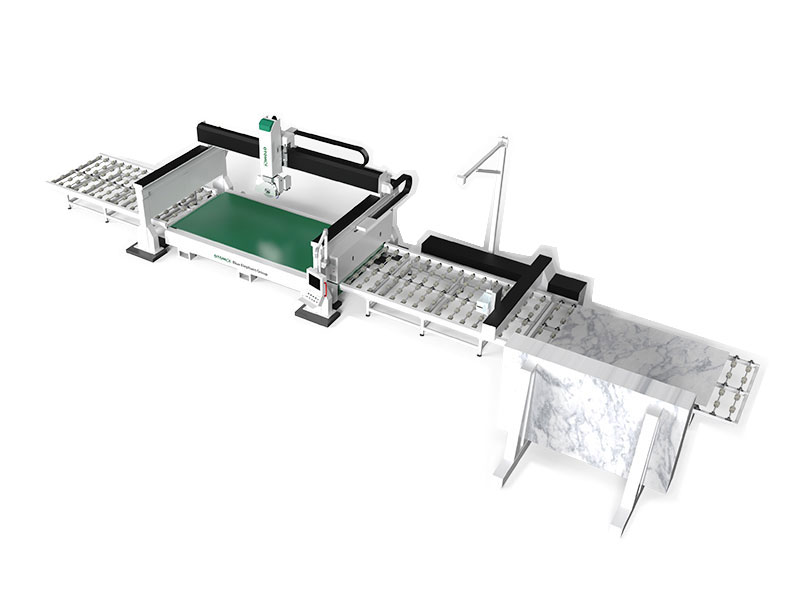
In the stone fabrication industry, choosing the right CNC bridge cutting saw has a direct impact on processing accuracy, production efficiency, labor costs, and the range of finished products you can offer. With multiple configurations available—4-axis, 4+1, 5-axis, and 5+1—understanding how these machines actually differ is essential for making a sound investment decision.
This guide explains their structural differences, machining capabilities, real-world applications, and selection criteria, helping stone processors match the right machine to their business needs.
1. 4-Axis Stone Bridge Cutting Saws: Stable and Cost-Effective
A standard 4-axis stone bridge cutting saw consists of three linear axes (X, Y, Z) and one rotational axis (A-axis) that controls blade rotation. This configuration allows the saw blade to rotate for angled cuts—typically 45°—while maintaining stable linear movement across the slab.
Key Capabilities
-
Straight cutting and diagonal cutting
-
Fixed-angle bevel cuts (commonly 45°)
-
Circular, rectangular, and polygonal shapes
-
Sink and cooktop cutouts
4-axis machines are widely used for granite, marble, and quartz slabs, especially in applications where designs are standardized and repetitive.
Best Use Cases
-
Kitchen countertops
-
Bathroom vanity tops
-
Window sills and stair treads
-
Large-scale architectural panels
Their biggest advantage lies in high efficiency, mechanical stability, and affordability, making them ideal for small to medium workshops focused on volume production rather than complex geometry.
2. 4+1 Stone Bridge Cutting Saws: Greater Flexibility Without Full 5-Axis Linkage
The term “4+1” does not indicate true 5-axis simultaneous machining. Instead, it usually refers to a 4-axis bridge saw equipped with an additional functional unit, such as:
-
A rotating or tilting cutting head
-
An auxiliary spindle
-
An automatic tool-changing or edge-processing function
These extra functions allow multiple operations to be completed in a single setup, even though all five axes do not move simultaneously.
What 4+1 Machines Improve
-
Reduced manual repositioning
-
More complex edge processing
-
Integrated cutting and polishing workflows
For example, a 4+1 stone bridge saw can cut a sink opening and then polish or chamfer the edge without unloading the slab. This significantly improves efficiency for customized countertop processing.
Ideal Applications
-
Customized sinks and basins
-
Irregular backsplashes
-
Decorative countertop edges
-
Medium-complexity architectural elements
4+1 machines are well suited for mid-sized stone workshops that handle varied orders but do not yet require full 3D spatial machining.
3. 5-Axis Stone Bridge Cutting Saws: True 3D Machining Capability
A true 5-axis stone bridge cutting saw features five axes moving simultaneously—three linear axes (X, Y, Z) plus two rotational axes (A and B). This configuration allows the saw blade to approach the stone from virtually any angle during cutting.
Core Advantages
-
Free-angle bevel cutting (not limited to 45°)
-
Back cutting and undercutting
-
Smooth curved and inclined surfaces
-
Reduced secondary grinding and polishing
Because the cutting angle continuously adjusts during machining, 5-axis machines deliver superior surface quality and dimensional accuracy, especially on complex stone shapes.
Typical Applications
-
Curved columns and pillars
-
Fan-shaped or radial stone panels
-
Sculptural architectural elements
-
High-end stone furniture
5-axis machines are essential for high-value, design-driven projects where precision, aesthetics, and complexity are critical.
4. 5+1 Stone Bridge Cutting Saws: Integrated High-End Production Systems
A 5+1 stone bridge cutting saw builds on true 5-axis technology by adding an auxiliary system, such as:
-
Additional spindles
-
Drilling or milling units
-
Automatic polishing heads
-
Advanced visual positioning or measurement systems
These machines are designed as multi-process stone machining centers, capable of completing cutting, drilling, chamfering, and edge finishing in one continuous workflow.
Why 5+1 Machines Stand Out
-
Fewer machines needed in the workshop
-
Reduced labor and handling
-
Higher consistency across large projects
-
Better utilization of skilled operators
For large-format quartz or sintered stone processing, a 5+1 system can complete an entire countertop—including cutouts and edge finishing—without transferring the slab between machines.
Best Fit For
-
Large stone factories
-
High-end architectural projects
-
Continuous, high-output production lines
Key Factors to Consider When Choosing
1. Project Complexity
-
Standard cuts → 4-axis
-
Mixed cutting and edge work → 4+1
-
Complex 3D designs → 5-axis / 5+1
2. Material Type
-
Thick granite and quartz require rigid frames and high-torque spindles
-
Large slabs benefit from machines with stable bridge structures and precise servo control
3. Production Volume
-
Small workshops → 4-axis or 4+1
-
Medium to large factories → 5-axis or 5+1
4. Budget Planning
-
Entry-level 4-axis machines are the most cost-effective
-
5-axis and 5+1 models involve higher upfront investment but offer greater long-term ROI through labor and process consolidation
5. Software and Automation
Look for:
-
CAD/CAM compatibility
-
Automatic toolpath generation
-
Visual positioning or slab measurement systems
OTOMIC CNC Stone Bridge Cutting Saw Model Comparison (4-Axis / 4+1 / 5-Axis / 5+1)
⚠️Note: Specifications may vary by configuration. The table reflects mainstream Blue Elephant setups used in stone fabrication.
OTOMIC CNC Stone Bridge Saw Comparison Table
| Item | 4-Axis Bridge Saw | 4+1 Bridge Saw | 5-Axis Bridge Saw | 5+1 Bridge Saw |
|---|---|---|---|---|
| Axis Configuration | X / Y / Z + A | X / Y / Z + A + functional unit | X / Y / Z + A + B (simultaneous) | 5-axis + auxiliary system |
| Axis Linkage | 4-axis linkage | No full 5-axis linkage | True 5-axis simultaneous | True 5-axis + automation |
| Blade Rotation | 0°–90° | 0°–90° | Any programmable angle | Any programmable angle |
| Head Tilting (B-axis) | ❌ | ❌ | ✅ | ✅ |
| Back Cutting / Undercut | ❌ | ❌ | ✅ | ✅ |
| Curved Surface Machining | Limited | Limited | Excellent | Excellent |
| Edge Processing | Basic | Integrated (cut + edge) | Advanced | Advanced + polishing |
| Typical Motor Power | 11–15 kW | 11–15 kW | 15–18.5 kW | 18.5 kW+ |
| Table Function | Fixed table | Fixed or tilting table | Tilting / rotating table | Hydraulic flip table |
| Automation Level | Basic | Medium | High | Very High |
| Operator Skill Requirement | Low | Low–Medium | Medium | Medium–High |
| Investment Level | ★ | ★★ | ★★★ | ★★★★ |
🔹 OTOMIC CNC 4-Axis Bridge Cutting Saw

- Stable structure
- Fast learning curve
- Lowest investment cost
- Excellent ROI for entry-level stone workshops
🔹 OTOMIC CNC 4+1 Bridge Cutting Saw

- One-time setup for multiple processes
- Improved efficiency without full 5-axis complexity
- Ideal upgrade from standard 4-axis machines
🔹 OTOMIC CNC 5-Axis Bridge Cutting Saw
- True 5-axis linkage
- Minimal secondary grinding
- Superior surface finish
- Essential for complex 3D stone geometry
🔹 OTOMIC CNC 5+1 Bridge Cutting Saw

- All-in-one stone machining center
- Reduced labor and handling
- Ideal for large factories and premium markets
- Long-term productivity and scalability
Which OTOMIC CNC Bridge Saw Should You Choose?
-
✔ Choose 4-axis if your focus is speed, standardization, and cost control
-
✔ Choose 4+1 if you want more flexibility without 5-axis complexity
-
✔ Choose 5-axis if your projects demand true 3D cutting and precision
-
✔ Choose 5+1 if you aim for maximum automation and high-end production
Conclusion
Choosing between 4-axis, 4+1, 5-axis, and 5+1 stone bridge cutting saws is not about selecting the most advanced machine—but the most suitable one for your production goals.
-
4-axis machines deliver efficiency and affordability for standardized work
-
4+1 machines add flexibility without the complexity of full 5-axis control
-
5-axis machines unlock true 3D stone machining
-
5+1 systems provide maximum integration for large-scale, high-end production
By aligning machine capability with application demands, material types, and budget, stone fabricators can make an investment that drives both productivity and long-term profitability.