Granite is a high-hardness, brittle natural stone that is prone to cracking and chipping. Granite cutting methods include manual cutting, CNC bridge saws, and CNC machines. Bridge saws offer high precision, efficiency, and stability, and are widely used in the stone industry.
This guide will introduce you to cutting tools, the cutting process, common challenges, and the best methods for achieving high-quality granite cuts.
1. What Tools Are Used to Cut Granite?
While there are many methods for cutting granite, not all are the best fit for your needs. CNC bridge saws, with their high precision, high efficiency, and high degree of automation, have become the most popular choice for your stone processing plant.
1.1 Angle Grinder
- Suitable for small-area cutting/trimming, local finishing, and small-size stone processing.
- It has advantages such as convenience and on-site processing, but disadvantages such as low precision, easy edge chipping, and high noise.
Auxiliary tools, not suitable for specialized granite processing.
1.2 Circular Saw
- Suitable for straight-line cutting, small sheet metal work, and DIY projects.
- It can efficiently cut straight lines and is more stable than an angle grinder. However, its precision is limited, it relies on manual operation, and it is not suitable for large-scale processing.
It meets the requirements of semi-specialized production, but is not suitable for factories.
1.3 Table Saw
- Suitable for small stone factories, featuring straight cutting and edge cutting functions.
- It offers better stability than hand tools, produces better straight-line cuts, and allows for repeated operation. However, it has limited processing size, is not suitable for large-sized boards, and suffers from poor flexibility and safety.
Small stone processing plants are not suitable for large-scale processing workshops.
1.4 Bridge Saw
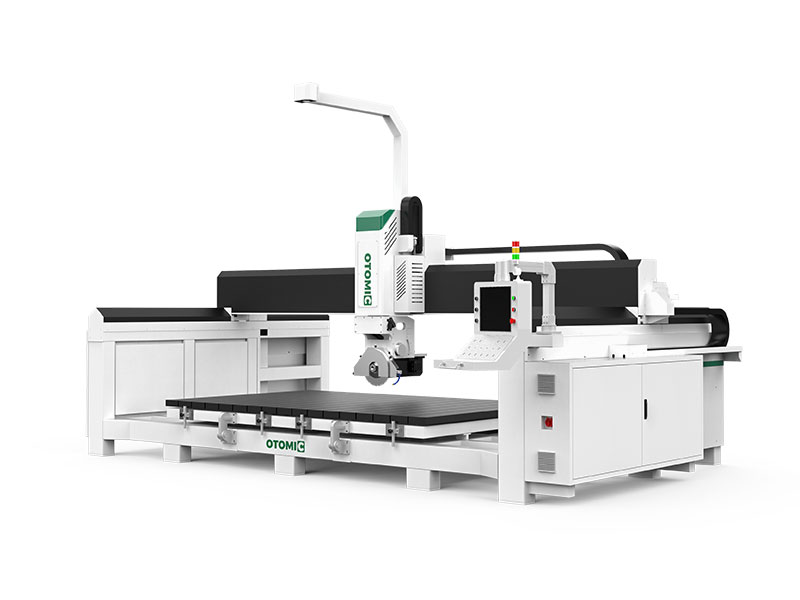
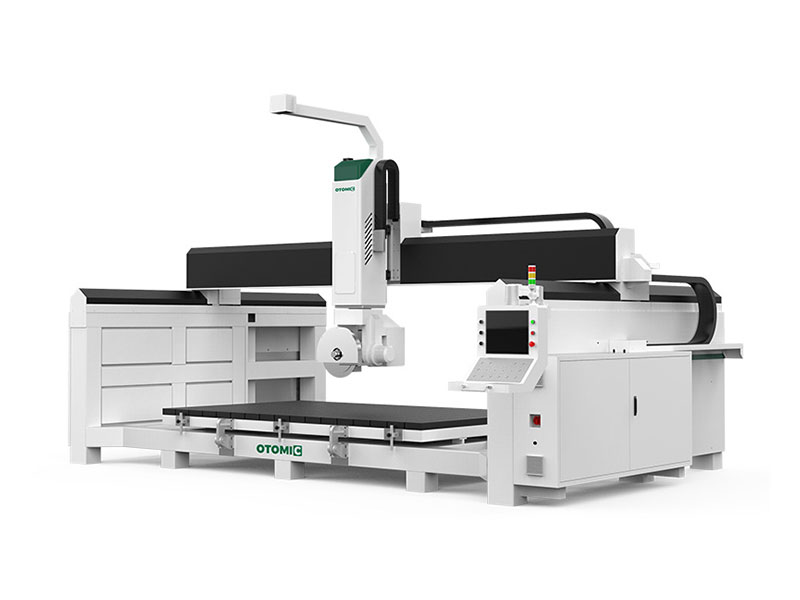
- Widely used in stone processing plants for slab cutting, this machine offers multiple functions including straight cutting, 45-degree beveling, and grooving, meeting the needs of mass production.
- High-precision and high-efficiency cutting with minimal edge chipping. The bridge-type structure offers good stability, suitable for automated production of large-size slabs. However, it requires a large footprint and some operator training.
The mainstream equipment in stone processing plants, providing the best solution for achieving both efficiency and precision.

OTOMIC CNC 4+1 CNC Bridge Saw with Material Moving Function
1.5 CNC Machine
- Suitable for high-end customized production of complex cuts, featuring carving and drilling functions.
- It boasts advantages such as high automation, complex processing capabilities, and high precision in batch production. However, it has high equipment costs, requires highly skilled operators, and its straight-line cutting efficiency is lower than that of a bridge saw.
Suitable for high-end automated factories, rather than single cutting tasks
2. How to Cut Granite with a CNC Bridge Saw (Step-by-Step)
Step 1: Inspect the granite slab
Inspect the granite slabs for cracks, hidden damage, or uneven thickness to ensure the material can be safely and properly cut.
Points to note:
Avoid using slabs with existing cracks to prevent the cracks from widening and causing breakage.
Step 2: Check the Bridge Saw and Blade
Confirm the equipment is operating normally and install a diamond saw blade suitable for granite.
Points to note:
- Blade wear affects cutting quality.
- Misaligned guide rails reduce precision.
- Ensure the water cooling system is functioning properly.
Step 3: Set Cutting Parameters
Set the cutting speed, spindle speed, and cutting depth according to the granite thickness.
Points to note:
- Excessive feed rate can cause chipping.
- Mismatched spindle speeds can lead to overheating or unstable cutting.
- Thick slabs are recommended for layer cutting.

Set Cutting Parameters
Step 4: Measure and Mark the Cutting Line
Measure and mark the sheet material according to the dimensional requirements, or use a CNC system for automatic positioning.
Points to note:
- Marking errors will directly affect the dimensional accuracy of the finished product.
- It is recommended to use a camera for automatic positioning to improve accuracy.
Step 5: Secure the Granite Slab
Use clamps or suction cups to secure the stone to the workbench to prevent movement.
Points to note:
- The slab must be completely stable.
- Any vibration will cause chipping or cutting misalignment.
Step 6: Start Water Cooling System
Turn on the water cooling system to continuously cool the blade during cutting.
Points to note:
- The water flow must cover the cutting area.
- Insufficient cooling will cause the blade to overheat and be damaged.
Step 7: Perform the Cutting
Start the bridge saw and cut smoothly along the set path.
Points to note:
- Maintain a uniform feed rate.
- Avoid sudden acceleration or deceleration.
- Do not force the blade forward.

Step 8: Finish and Polish the Edges
After cutting, grind or polish the edges.
Points to note:
Remove burrs to improve appearance quality.
Step 9: Clean the Work Area and Slab
Clean up cutting residue and dust, keeping equipment and materials clean.
Points to note:
- Prevent residue from affecting subsequent processing.
- Regular cleaning helps with equipment maintenance.
3. Common Problems When Cutting Granite
Common granite cutting problems (such as edge chipping, cracking, low precision, and low efficiency) are directly related to equipment stability, human operation, equipment parameters, and the degree of automation.
3.1 Chipping
The main reasons are unsuitable blades, excessive feed speed, and improperly secured stone. Chipping causes edge wear, increasing grinding time. Severe damage to the sheet material results in waste. This affects your final cutting results and leads to product quality issues.
3.2 Cracking
The main reasons are internal stress or microcracks in the granite and unreasonable cutting paths. This can cause the slab to be scrapped outright, and cracking may continue even after installation, affecting the quality of your finished product.

Common problems in granite cutting: cracks
3.3 Inaccurate Cutting
The main reasons include errors in manual measurement, insufficient precision of the guide rails, and unstable manual operation. Inaccurate cutting results in dimensions not meeting requirements. Reprocessing increases work time and reduces cutting efficiency. Material waste increases your costs.
3.4 Low Efficiency
The main reasons are over-reliance on manual operation, low automation levels in the equipment, and unsuitable or severely worn blades. This will lead to low production efficiency, extended delivery cycles, and reduced overall project profits.
4. Manual vs Bridge Saw vs CNC
For most granite processing companies, bridge saws achieve the best balance between precision, efficiency, and cost, making them the most practical solution for daily production.
| Factor | Manual | Bridge Saw | CNC Machine |
| Precision | Low | High | Very High |
| Efficiency | Low | High | High |
| Labor Dependency | High | Medium | Low |
| Automation | None | Semi | Full |
| Cost | Low | Medium | High |
| Application | DIY | Fabrication Shops | Advanced Production |
5. Best Way to Cut Granite Efficiently
Hand tools are suitable for small or occasional tasks. CNC machine tools, on the other hand, are ideal for complex and automated production. Bridge saws achieve a perfect balance of precision, efficiency, and cost, creating more value for you and making them the best choice for most granite cutting applications.
5.1 High Precision Ensures High-Quality Cutting Results
The bridge saw employs a rigid bridge structure and guide rail system, ensuring stability throughout the cutting process. Automatic positioning guarantees cutting accuracy. Its precision meets most processing needs, especially suitable for cutting tabletops and slabs.

High Precision Bridge Saw
5.2 Increases Productivity by 30%
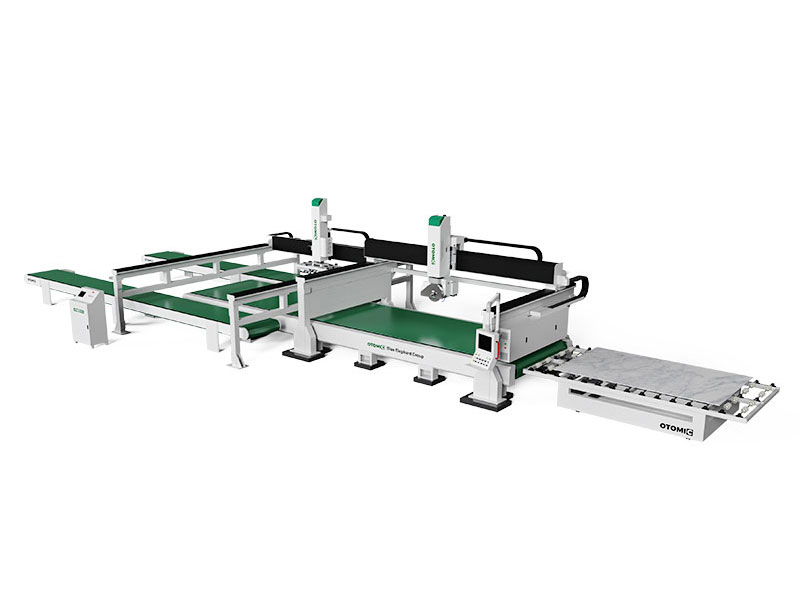
Designed specifically for cutting large granite slabs, the bridge saw is ideal for stone processing workshops. It allows for continuous, uninterrupted processing, reducing downtime and increasing production efficiency and overall profits.
5.3 Reduces Labor Costs by 25%
Bridge saws are simple to operate and easy to learn, reducing reliance on manual labor and high-skill requirements. A perfect balance is achieved between ease of use and operational control.
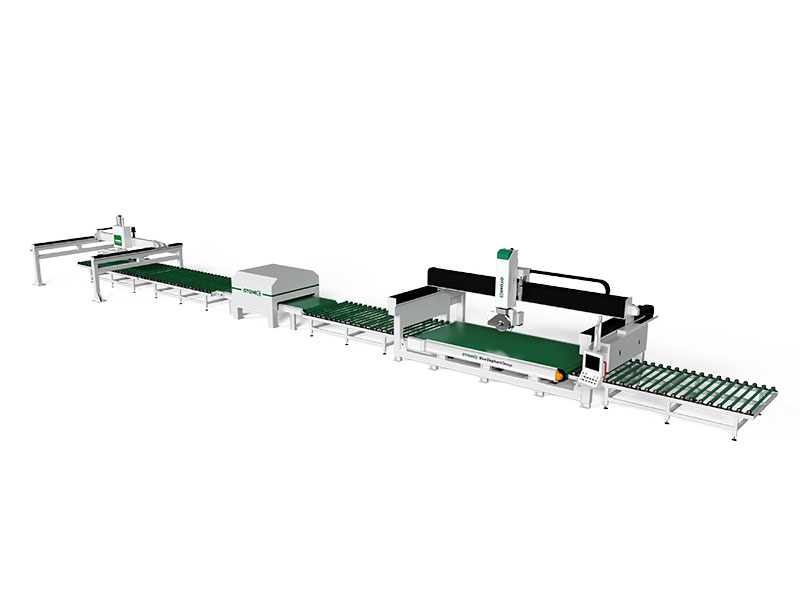
5.4 Automation Suitable for Batch Slab Processing
The bridge saw’s semi-automatic or CNC control system is simple to set up, easily enabling batch production without complex programming.
5.5 Best Cost-Effectiveness Improves ROI by 35%
Compared to CNC machine tools, the bridge saw requires a lower initial investment while still providing superior performance. Bridge saws offer a better balance between functionality and cost, delivering the best return on investment for stone processing businesses.

Cost Effectiveness Bridge Saw
5.6 Ideal for Granite Slab Cutting
Bridge saws are designed for the following applications:
Granite slab cutting
Countertop processing
Straight and bevel cutting
For standard stone processing tasks, bridge saws are the most practical and widely used solution.


6. Key Parameters for Cutting Granite
| Parameter | Typical Range / Selection | Impact on Cutting |
| Cutting Speed (Feed Rate) | 1–3 m/min | Too fast → chipping, rough edges
Too slow → low efficiency, increased blade wear |
| Spindle Speed (RPM) | 1500–3000 RPM | Too high → overheating, faster wear
Too low → inefficient cutting, poor finish |
| Blade Type | Continuous Rim / Segmented Diamond Blade | Wrong blade → chipping, poor cutting quality |
| Cutting Depth | Single pass (thin slabs)
Multiple passes (thick slabs) |
Too deep → risk of cracking
Too shallow → reduced efficiency |
| Water Flow | Continuous flow (full coverage of cutting area) | Insufficient cooling → overheating, blade damage
Poor flow → reduced cutting quality |
Values may vary depending on granite hardness, slab thickness, and machine specifications.
7. FAQ
Q1: Can granite be cut without a bridge saw?
Yes, granite can be cut using hand tools such as an angle grinder. However, these methods are generally less precise and prone to chipping or uneven cuts. For a more professional cutting effect and higher efficiency, a bridge saw is recommended.
Q2: What is the best machine for cutting granite?
The best machine for cutting granite depends on the specific application. Bridge saws are widely used for most granite cutting tasks. They strike a good balance between precision, efficiency, and cost. CNC machine tools are better suited for complex designs but require a higher investment cost.
Q3: How to Avoid Chipping When Cutting Granite?
To avoid chipping, use a high-quality diamond saw blade and maintain a consistent cutting speed. Proper water cooling and slab stability are also important. Reducing vibration during the cutting process will improve the quality of the cut edge.
Q4: Which saw blade is best for cutting granite?
Diamond saw blades are the best choice for cutting granite. Continuous saw blades provide a smoother edge cut, while segmented saw blades are better suited for faster cuts. Choosing the right saw blade depends on your trade-offs regarding cut quality and speed.
Q5: How thick can granite be cut?
Most bridge saws can cut granite slabs ranging from 10 mm to over 50 mm in thickness. Thicker slabs typically require multiple cuts to prevent cracking. Specific cutting capacity depends on the machine and saw blade size.
Q6: What are the main applications of granite cutting?
- Kitchen Countertops
- Bathroom Sinks
- Flooring and Tiles
- Wall Finishes
- Staircases and Steps
- Construction Projects
8. Conclusion
Granite cutting tools include manual, bridge saw, and CNC machines. Manual tools are suitable for small-volume cutting tasks, while bridge saws and CNC machines are suitable for large-scale processing tasks. The choice of cutting method depends on the specific requirements of your project.
OTOMIC CNC Bridge saws are specialized machines widely used in most stone processing plants, achieving the best balance between cutting accuracy, efficiency, and cost-effectiveness. Choosing the right bridge cutter can improve your efficiency and cutting quality, reduce labor costs, and achieve a higher return on investment.