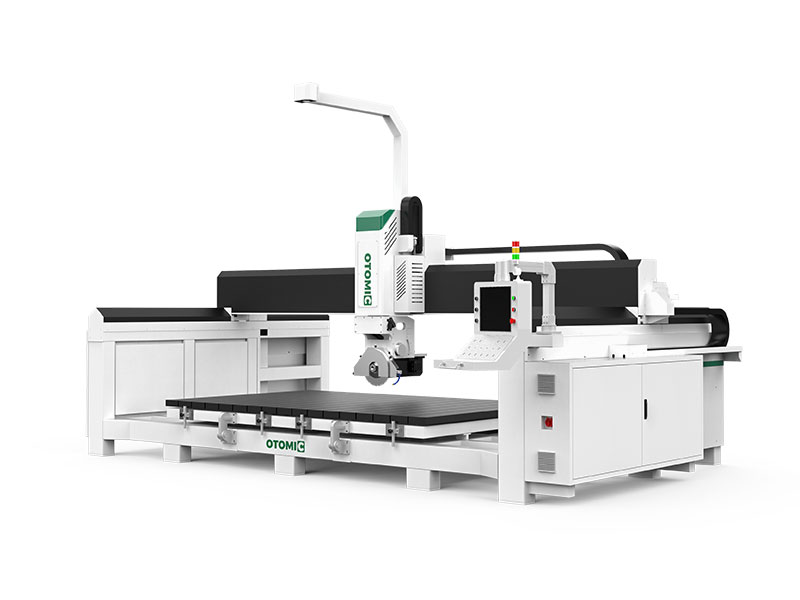
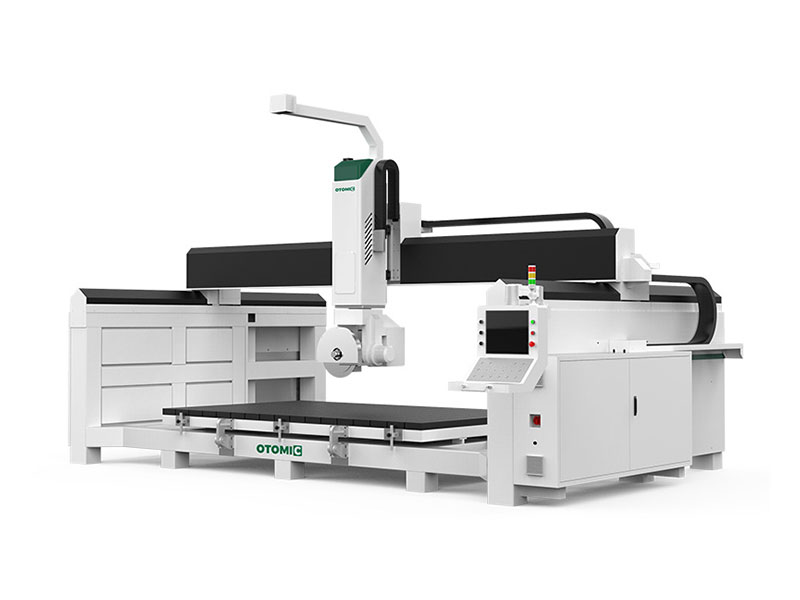
In modern stone fabrication, bridge cutting saws are essential CNC machines used for accurately cutting marble, granite, quartz, and sintered stone slabs. By combining a rigid mechanical structure with precise motion control and automated CNC systems, bridge saws deliver consistent accuracy, high efficiency, and excellent surface quality. Understanding their operating principles is key to maximizing performance and production value.
1. Structural Framework: The Bridge (Gantry) Design
The defining feature of a stone bridge cutting saw is its overhead bridge (gantry) structure, which spans the working table and supports the cutting head assembly. This design ensures high rigidity, stable load distribution, and smooth motion during cutting operations.
The bridge typically moves along the X-axis, while the cutting head travels along the Y-axis and Z-axis, allowing full coverage of large-format stone slabs. High-quality machines use reinforced steel or cast-iron gantries combined with precision linear guides and servo drives to minimize vibration and maintain cutting accuracy.
For example, a 4+1 bridge cutting saw, commonly used in quartz countertop processing, is designed for heavy-duty slab handling and stable long-term operation. Its axis configuration allows vertical cutting, straight cutting, and angle cutting (commonly up to 45° or 90°), making it suitable for sink cutouts, edge shaping, and standard profiling tasks.
2. Cutting Mechanism: Diamond Blade Rotation and Linear Motion
Stone bridge saws rely on a diamond circular blade to cut hard stone materials. The blade is driven by a high-power spindle motor, typically operating at 2,800–6,000 RPM, which is the optimal speed range for stone cutting (rather than ultra-high spindle speeds used in metal or wood CNC machines).
Cutting accuracy is achieved through the coordinated movement of the blade and bridge system:
-
Rotational motion of the diamond blade performs the cutting
-
Linear motion along the X and Y axes defines the cutting path
-
Vertical Z-axis movement controls cutting depth
During operation, the CNC controller precisely synchronizes these motions to produce straight cuts, arcs, miters, and complex profiles. In countertop fabrication, operators can program sink openings, faucet holes, and edge lines directly into the CNC system, ensuring consistent results across multiple slabs with minimal material waste.
3. Slab Fixing Systems: Stability and Accuracy
To ensure cutting precision and prevent slab movement, stone bridge cutting saws use multiple fixing methods depending on material type and surface condition.
Vacuum Suction System
For polished marble, quartz, or sintered stone slabs, vacuum suction cups are widely used. These cups create negative pressure to firmly hold the slab without surface damage, making them ideal for finished or high-value materials.
Mechanical Clamping System
For rough, uneven, or thick stone slabs, mechanical clamps are applied along the slab edges. These clamps are adjustable and designed to resist cutting forces without introducing stress or deformation.
The combination of vacuum fixation and mechanical clamping ensures stable positioning during both straight cutting and angled cutting operations.
4. Cooling and Dust Suppression: Tool Protection and Workplace Safety
Stone cutting generates significant heat and fine dust, especially when processing hard materials such as granite or quartz. To address this, bridge cutting saws are equipped with water-based cooling systems.
-
Continuous water flow cools the diamond blade
-
Reduces friction and prevents blade overheating
-
Improves cutting quality and extends blade lifespan
-
Suppresses stone dust at the cutting point
Unlike woodworking CNC machines, stone bridge saws rely primarily on wet cutting rather than vacuum dust extraction. Water effectively controls airborne dust, protects machine components, and improves operator safety in compliance with environmental and workplace regulations.
5. CNC Control and Automation: From Manual Operation to Intelligent Cutting
Modern stone bridge cutting saws are controlled by CNC systems that automate the entire cutting process. Operators can import CAD drawings (DXF, PLT formats) into the control system, define cutting parameters, and execute jobs with minimal manual intervention.
Advanced models support:
-
Automatic toolpath calculation
-
Angle cutting and interpolation
-
Multi-step processing without repositioning
-
Real-time status monitoring and fault alerts
For example, a 4+1 bridge cutting saw allows operators to complete straight cutting, angle cutting, and basic edge processing within a single setup, significantly improving efficiency in kitchen countertop and vanity production.


Conclusion: A Core Technology in Modern Stone Fabrication
Stone bridge cutting saws represent the foundation of modern stone processing. Their success lies in the integration of a rigid bridge structure, precise motion control, efficient wet cutting, and intelligent CNC automation. These machines enable fabricators to meet the growing demand for accuracy, consistency, and productivity while reducing labor intensity and material waste.
As CNC technology continues to evolve, bridge cutting saws are moving toward higher levels of automation, smarter positioning systems, and greater processing integration—ensuring they remain indispensable equipment in the stone fabrication industry.
Whether you are upgrading an existing workshop or building a new production line, understanding how stone bridge cutting saws work is the first step toward achieving higher quality and long-term competitiveness.